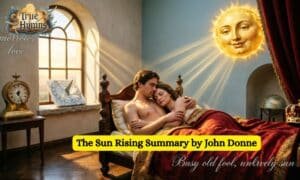

Busy old fool, unruly sun,
Why do you knock at our quiet dawn?
Through windows and through curtains you call on us,
As if love must rise at your command.
Love has no season,
No hours, days, months,
No rags of time to bind it.
You shine with beams so reverend and strong,
Yet I could eclipse you with a wink,
If her eyes were not my true sunrise.
Go chide late school boys,
And sour prentices half asleep,
Leave lovers in their golden dream.
Go tell court huntsmen the king will ride,
Call country ants to harvest offices,
Let the world march to your rhythm.
But here, in this small room,
The world is contracted thus,
All kings lie quiet in one bed.
She’s all states, and all princes I,
Nothing else is beyond her breath,
All honor’s mimic beside her smile.
Both th’ Indias of spice and mine
Are richer in her gentle gaze,
Than ships that cross wide oceans.
In he Sun Rising we learn,
That love outshines the sky,
And time bows down softly.
In he Sun Rising desire speaks,
Bold against the morning light,
Fearless before burning gold.
In he Sun Rising hearts whisper,
That this bed is the center,
And these walls are the only sphere.
Shine here if you must, old sun,
Warm the world by warming us,
And be half as happy as we are.
“The Sun Rising” Summary
The Sun Rising by John Donne is a love poem in which the speaker talks directly to the sun. He angrily calls it a “busy old fool” and questions why it disturbs him and his beloved. He tells the sun to go wake schoolboys, workers, and court huntsmen instead of bothering lovers. For him, love does not follow time, seasons, or worldly schedules.
As the poem continues, the speaker boldly claims that his beloved is more valuable than all the riches of the world, even “both th’ Indias of spice and mine.” He says she is “all states,” and he is “all princes,” meaning their love contains the entire world. In the end, he declares that their bed is the center of the universe. The poem celebrates romantic love as powerful, timeless, and greater than kings, wealth, and even the sun itself.